How to Start Running from Zero — and Not Quit Within a Week
Updated: January 30, 2026
Most beginner running plans fail in the first ten days. Not because the runner is weak, but because the plan is unrealistic. This is the on-ramp I wish someone had handed me on my own first day — gentle enough to feel doable, structured enough to feel like a path.
Why the first week matters most
The body adapts to running slowly. The mind, on the other hand, decides whether to keep going within the first three sessions. According to experts cited in WHO wellness summaries, regular gentle movement is one of the most consistent contributors to general well-being. The trick is making “regular” feel possible from the very first try.
The four-week on-ramp
This plan is designed for someone who is currently doing little to no running. It is not a competitive programme. It assumes nothing about pace or distance — only about minutes spent outside, moving comfortably.
Week 1 — Walk with intent
- Three outings, 25 minutes each, brisk walking only.
- Focus on relaxed shoulders and easy breathing through the nose.
- Pick the same time of day each session.
Week 2 — Add gentle jogging
- Three outings, 28 minutes each: walk 4 min, jog 1 min, repeat.
- The jog should feel slower than you think it should.
- If you can sing, the pace is right.
Week 3 — Grow the jogs
- Three outings, 30 minutes each: walk 3 min, jog 2 min, repeat.
- Notice how your breath finds a softer rhythm in the second half.
Week 4 — A continuous gentle run
- Three outings: one easy 20-minute continuous jog, two of last week’s walk-jog routine.
- If 20 minutes feels too long, do 15. The number is a guide, not a verdict.
“You are not building a runner in four weeks. You are building someone who likes running. That is a longer project, and a kinder one.”
What to expect emotionally
The first two weeks usually feel awkward. The third week often feels surprisingly good. The fourth week is where many people quietly fall in love with the habit. The trajectory is rarely a straight line, and that is fine. In my experience, the people who keep running are the ones who view a missed session like a missed bus — annoying, not catastrophic.
How to talk to yourself on hard days
The voice in your head matters more than the watch on your wrist. On grey mornings I use two simple sentences: “Just the first ten minutes.” and “I am not racing today.” Both have rescued more runs than any energy gel ever did. Harvard wellness columns have written about the role of self-talk in sustaining gentle habits, and the idea matches what my notebook keeps showing me.

Mistakes that quietly end the habit
- Going too fast on day one and feeling sore for a week.
- Tracking too many metrics before the habit is established.
- Comparing your weekly distance with someone else’s social-media graph.
- Trying to make up missed sessions by doubling up the next day.
Beyond week four
Once a 20-minute easy jog feels approachable, you have a stable platform. From here, growth is slow and friendly. Add five minutes every second week. Add one extra outing only after a month of comfortable three-a-weeks. Comfortable pace is the floor under everything else; never sacrifice it for a chart.
Friendly extras that quietly help
A few small habits make the on-ramp friendlier. The first is a one-line journal: after each outing, write a single sentence about how it felt. Even a two-word entry like “windy, easy” becomes valuable a month later when you read the pattern. The second is a low-effort warm-up: ankle circles, three slow lunges, and one minute of marching in place. None of this is a programme; it is a small ritual that turns the doorway into a starting line.
The third is a route library. I keep four loops in my head — 1.5 km, 2.5 km, 3.5 km, and 5 km — all starting and ending at my front door. Whatever the weather and mood, one of these loops fits. Harvard wellness columns have written about how reducing friction in small ways generally promotes adherence to gentle habits; the route library is exactly that idea, in practical form.
How to know you have arrived
You will not feel transformed. You will, however, notice three quiet signs. You will get dressed for a run without negotiating. You will plan trips around your loops without thinking about it. And you will recommend the slow start to a friend, in your own words, with a small smile. At that point, you are a comfortable-pace runner. The on-ramp is over and the long, kind road has begun.
3 steps you can start today
Begin tomorrow morning
- Pick three days in the next seven and write them in your calendar like meetings.
- Lay out your shoes and shirt the night before each session.
- On the first day, only commit to going outside and walking for ten minutes. The rest is a bonus.
FAQ
What if I miss a week?
Restart the previous week, not the next one. Continuity matters more than perfection.
Should I run in the rain?
Light rain is friendly. Heavy storms and ice are good reasons to skip a day and read a book instead.
How do I know my pace is comfortable enough?
If you cannot hold a short conversation with a friend (or with yourself), slow down for two minutes and try again.
This content is for informational purposes only and is not a substitute for professional advice. Consult a qualified specialist before starting any new fitness or wellness program. Information on this blog is based on open sources and personal experience. It does not replace medical consultation.
Read also
Minimal Running Gear
The short list that survived three seasons.
Read articleMorning Run vs Evening Run
Two windows, two moods, one comparison.
Read articleJoin the calm-pace newsletter
Weekly notes on pulse, breathing, and gentle running. No noise, just a quiet nudge.
Morning Run vs Evening Run: Which One Suits a Comfortable Pace
Updated: February 22, 2026
For a full year I alternated between morning runs and evening runs, week by week, with the same comfortable pace and the same route along the Toronto waterfront. By the end of that year, I had filled a small notebook with notes, pulse averages, and very personal impressions. This is the honest comparison.
How I set up the experiment
This was not a scientific study. It was a personal note. Three runs per week, fifty weeks, comfortable conversation pace, same loop, same shoes. The only variable was the time of day. The notebook tracked four things: pulse average, mood before, mood after, and a one-word descriptor of the run itself.
Mornings: clear and quiet
Morning runs felt like clean pages. The streets were empty, the air smelled different, and my mind had not yet been filled by the day. The downside was the first ten minutes — my legs felt stiff, my pulse climbed quickly, and the first half of the route was always a negotiation with grogginess.
According to experts often cited in wellness columns, morning movement generally promotes a more settled mood throughout the day. My notebook agreed. The “mood after” column for morning runs was almost always one notch higher than the “mood before”.
“Morning is the part of the day that listens.” — a friend who runs at 6:15 a.m. without complaint
Evenings: warm and social
Evening runs felt like a long exhale. My body was already loose from the day. My pulse settled into a comfortable rhythm within the first kilometre. The streets were busier, the light was softer, and conversations on the trail were friendlier.
The downside was the trade-off with sleep. On nights when I ran later than 9 p.m., I noticed my sleep was slightly more restless. WHO wellness summaries note that the timing of regular activity may interact with sleep patterns, and my evenings confirmed that gently.
Pulse and pace, side by side
Pulse-wise, the two windows were closer than I expected. The average difference across the year was small, well within the noise of any single run. The bigger differences were qualitative. Mornings felt sharp. Evenings felt round. Neither was better. They were simply different rooms in the same house.
Where each one wins
- Mornings win for consistency, focus, and the quiet of an empty city.
- Evenings win for social runs, warm legs, and pretty light.
- Both win when you simply pick the one that fits your real schedule.
My current rhythm
After the year was done, I settled into a mostly-morning routine with one evening run on Wednesdays, when a friend joins me. The “mostly” matters. Comfortable pace is friendlier to flexibility than to rules. If a morning is impossible, the evening is still here, waiting.
What I would tell a beginner
Start with the time of day that requires the least negotiation with the rest of your life. If you are a night owl, do not force a 6 a.m. start; you will quit. If you live with kids and the evenings are chaos, mornings will be your friend. A run you actually do at the wrong time is better than a perfect run you never do.
Seasonal notes from the notebook
The two windows behave differently across the seasons in southern Ontario. In summer, mornings are kinder, because the heat builds quickly after eight a.m. and the evening air can stay warm long past sunset. In winter, evenings are a little gentler in feel — the city is already lit, the wind has often dropped, and the route home leads to a warm room rather than a cold breakfast. Spring and autumn make almost no difference; both windows are pleasant, and the only deciding factor is the calendar.
One pattern surprised me. On weeks where I switched my window mid-week, I felt unsettled, even though each individual run felt fine. Comfortable pace likes a steady appointment. According to experts in habit-formation columns, repetition of context is a quiet contributor to the persistence of any gentle routine.
If you cannot choose
When in doubt, pick mornings for one full month, then switch to evenings for the next month. After two months, your notebook will have written the answer for you. There is no need to debate this in advance. The body and the calendar will decide together, and they tend to be honest with each other.
3 steps you can start today
Try this in the next two weeks
- Pick a route close to home — ideally a loop of two to four kilometres.
- Run it three times in the morning and three times in the evening, comfortable pace only.
- After two weeks, write down one word for each run. The pattern will tell you which window is yours right now.
FAQ
Is one time of day truly better than the other?
Not in any universal sense. The “better” window is the one that fits your day, your sleep, and your mood. Consistency matters more than the clock.
Will evening runs disturb my sleep?
In my experience, runs that ended at least two hours before bedtime did not affect sleep noticeably. Later runs sometimes did. Your mileage may vary.
What about lunch-break runs?
Midday is a wonderful middle ground if your schedule allows it. The route just needs a quick way to freshen up afterwards.
This content is for informational purposes only and is not a substitute for professional advice. Consult a qualified specialist before starting any new fitness or wellness program. Information on this blog is based on open sources and personal experience. It does not replace medical consultation.
Read also
Minimal Running Gear
What survived three seasons of slow miles.
Read articleStart Running from Zero
A gentle four-week on-ramp.
Read articleJoin the calm-pace newsletter
Weekly notes on pulse, breathing, and gentle running. No noise, just a quiet nudge.
Minimal Running Gear: Where I Spent Less (and Where I Did Not)
Updated: March 4, 2026
Three seasons ago I stripped my running gear down to seven items. Two of them are free. One was a gift. The rest I bought on sale, on a quiet Tuesday, after reading too many forum threads. Here is the short, honest list — what I kept, what I dropped, and why a comfortable pulse does not actually need much equipment.
The starting point: too much stuff
Back when I first started running, I thought I needed a kit for every season, a watch for every metric, and a shelf full of nutrition products. By the end of the first year I had spent more on accessories than on the shoes themselves. None of that gear made me faster. It mostly made my hallway closet noisier.
What survived: the short list
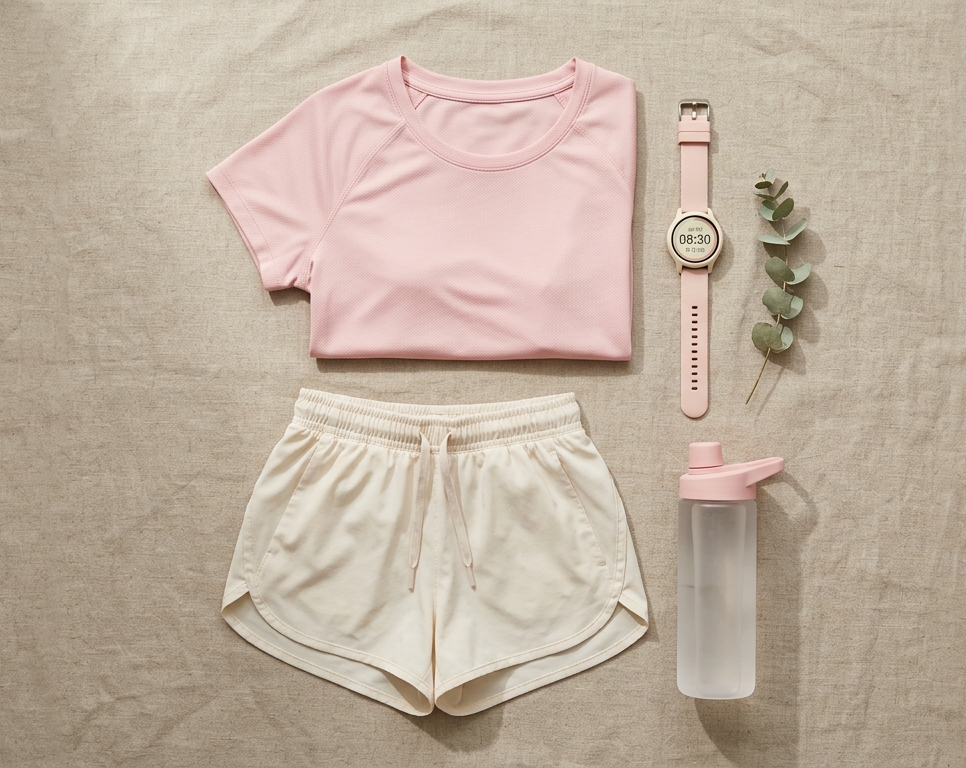
- One pair of neutral running shoes, replaced every twelve to eighteen months.
- One pair of moisture-wicking socks, washed twice a week.
- Two simple shirts — one light, one slightly warmer.
- One pair of shorts and one pair of tights.
- A thin windproof jacket for shoulder seasons.
- A basic wrist watch for pulse and time of day.
- A reusable water bottle for the days I run loops near a tap.
“The best running gear is the gear you forget you are wearing.” — a regular at the Withrow Park run club
Where I happily spent less
I stopped buying premium fabrics for every season. A basic synthetic shirt from a mid-range brand works as well as a flagship item for ninety percent of my runs. According to experts quoted in long-form running magazines, the difference between mid-range and top-tier wellness apparel is often marginal once the basics are covered: breathability, fit, and weight.
Where I did not skimp
Shoes. That is the entire list. A well-fitted, neutral shoe with sensible cushioning rescued my comfortable-pace habit more than any other item. WHO specialists note that sensible footwear generally supports posture and balance — that line plays out on every long, slow kilometre. I rotate two pairs, log the total kilometres, and replace them when they feel “spongy” on the inside.
The gear I quietly dropped
- Compression sleeves I never noticed during a run.
- An ultralight vest with eight pockets I never filled.
- A second watch I bought as a “backup” and used twice.
- A heart-rate chest strap that mostly logged the wrong values when wet.
What changed when the gear got smaller
The biggest change was psychological. With fewer items to fuss over, getting out the door took less time. My morning prep shrank to a thirty-second routine: pull on the kit, lace the shoes, walk down the stairs. In my experience, that low friction is what keeps the habit alive on grey March mornings when motivation is thin.
A small budget plan
If I were starting over today with a tight budget, I would spend most of it on shoes from a specialty store with a real fitting, and the rest on two synthetic shirts and one pair of shorts. Everything else can come later, slowly, as the habit grows. Buying everything in week one is the fastest way to lose interest by week six.
How I care for what I own
The second half of minimalism is maintenance. A small kit only stays small if each item lasts a long time. I wash shirts and shorts on a gentle cycle in cool water, hang everything to dry indoors, and rotate the two shirts so neither one carries the entire load. Shoes get a soft brush after muddy outings and an evening on a wooden shoe-tree to keep their shape. None of this takes more than a few minutes a week, but it adds whole seasons to the lifetime of a basic kit.
I also keep a small note inside my closet door: the kilometre count on each pair of shoes and the month I bought them. When the spongy feeling arrives, the note tells me whether I am being too eager or whether the shoes have honestly earned retirement. According to experts in long-form running media, paying gentle attention to gear extends both the lifespan of the items and the patience of the wearer.
What I tell friends who ask
When friends ask what to buy first, my answer is always the same. Go to a specialty store on a quiet weekday afternoon. Let someone watch you walk. Try on at least three pairs. Choose the boring colour that feels best, not the bright one that looks best. Then go home, lace them up, and walk around the block. That is the whole shopping list for the first six weeks. The rest can wait until you actually know what you want.
3 steps you can start today
Try this small reset
- Lay out every running item you own on the floor. Sort into “used this month” and “did not use”.
- Donate or sell three items from the “did not use” pile. Notice how much lighter the closet feels.
- Plan your next purchase only after you have run consistently for two weeks with what remains.
FAQ
Do I really only need one pair of shoes?
One well-fitted pair is enough to start. After the first six months, a second pair is helpful so the cushioning has time to bounce back between runs.
Is a fancy watch worth it for slow running?
For comfortable-pace work, a simple watch that shows time and pulse is plenty. The rest is nice but not necessary.
What about cold winter days?
A thin base layer, a windproof jacket, and a soft beanie cover most Canadian winter mornings down to about minus ten Celsius for a thirty-minute run.
This content is for informational purposes only and is not a substitute for professional advice. Consult a qualified specialist before starting any new fitness or wellness program. Information on this blog is based on open sources and personal experience. It does not replace medical consultation.
Read also
Morning Run vs Evening Run
Two pulses, two moods, one honest comparison.
Read articleStart Running from Zero
A gentle four-week on-ramp without the burnout.
Read articleJoin the calm-pace newsletter
Weekly notes on pulse, breathing, and gentle running. No noise, just a quiet nudge.